The Labyrinth
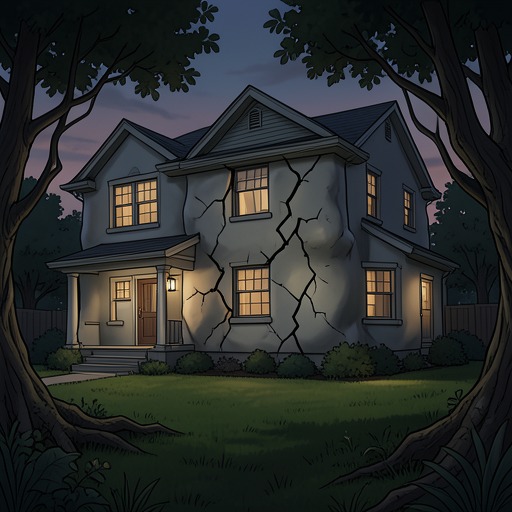
House of LeavesThe Labyrinth is the central spatial and formal concept used to describe the impossible architecture of the Navidson house and the fragmented film that records it. It emerges when ordinary echoes and measurements can no longer explain the building: dimensions contradict the plans, children’s voices travel through distances the house should not contain, and a doorless hallway appears where no corridor ought to exist. The labyrinth therefore signifies more than a maze of rooms. It is a system in which perception, orientation, representation, and interpretation repeatedly fail, while the effort to understand becomes part of the danger.
Definition and Architectural Emergence
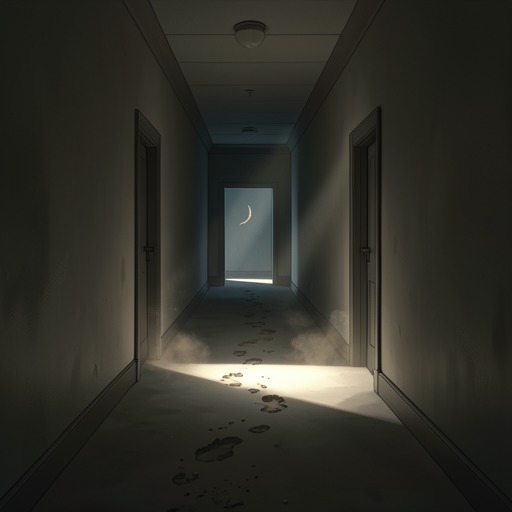
The concept becomes necessary after Navidson compares the house plans with measurements taken using a 25-foot Stanley Power Lock. The exterior distance between the master bedroom and the children’s bedroom measures 32 feet 9 3/4 inches, agreeing with the plans within an inch, yet the interior dimensions cannot be reconciled with that outside measurement. The discrepancy is not a minor surveying error but an impossible remainder: the house contains more space than its walls allow. When Chad Navidson and Daisy Navidson call from a distance of fifty feet, and then fifty-six and a half feet, despite the house having no room longer than twenty-five feet, the children’s voices produce separate answering echoes. Navidson follows those echoes into a dark, doorless hallway that has appeared in the west wall, carrying the children back out while Karen Green remains frozen at the threshold.
The labyrinth is consequently defined by unstable boundaries and excess interiority. It is not merely a complicated arrangement built according to a hidden plan; it is a place whose dimensions and connections can change, making the distinction between architectural error and architectural transformation impossible to maintain. Karen’s later discovery that the bookshelves have become flush with the walls and that the closet space has vanished confirms that the house can revise its own apparent history. When she opens the north-wall door and finds only a shallow closet, the earlier corridor is absent rather than solved. The structure does not yield a stable answer; it replaces one spatial fact with another.
Historical and Mythic Models
The discussion of labyrinths distinguishes several historical purposes. An English hedgerow maze at Longleat was designed to amuse garden-party visitors, while Amenemhet III constructed a labyrinth near Lake Moeris for a mortuary temple, where its protective function was connected with the preservation of the soul. These examples establish that a labyrinth may be recreational, funerary, protective, or carceral rather than inherently evil. Its meaning depends on what it encloses, whom it admits, and what kind of passage it demands.
The most important model is the labyrinth attributed to Daedalus for King Minos at Knossos. In the familiar myth, the maze imprisons the Minotaur, a creature with a bull’s head and a man’s body, who devours Athenian youths until Theseus kills him. The text revises the moral and architectural implications of that story by speculating that Minos may have built the labyrinth not to contain a monster but to conceal a deformed child, his own heir. On this reading, the maze is a structure of shame and concealment: architecture protects authority by hiding what its ruler cannot accept. The myth thus supplies a possible analogue for the Navidson house, whose impossible interior may be understood not as a neutral puzzle but as a space where fear, secrecy, and rejected knowledge acquire physical form.
Inside and Outside
Penelope Reed Doob’s distinction between those who walk inside a labyrinth and those who observe it from outside becomes decisive for the house. A maze-treader has severely restricted vision ahead and behind, while an external observer can supposedly perceive the larger pattern. The Navidson house defeats this distinction because nobody ever sees its labyrinth in its entirety. Even those who study the footage must derive their understanding from partial movements through the structure. Comprehension is therefore produced from within, under the same restrictions that govern the explorers’ experience.
The film itself reproduces this condition. Its jump cuts destroy continuity, its wall-shifts prevent the construction of an accurate bauplan, and its sequences offer empty rooms, long corridors, and dead ends that promise a complete layout while continually withholding one. The viewer moves from one fragment to another in search of a center, a solution, or a whole, only to encounter another divergence. The house and the film capture their observers at the same moment that they permit wandering: both offer movement without an external vantage point from which movement can be fully understood.
Labor, Orientation, and the Failure of Mastery
The word labyrinth is connected in the discussion to Latin labor and to labi, meaning to slip or slide backward. This etymological association changes the maze from a static puzzle into a demand placed upon the body. To remain inside it requires effort, vigilance, and resistance to falling or losing ground. The problem is not simply that the route is difficult; exhaustion is part of the structure’s power. Anyone trying to escape must choose only the paths necessary for departure, because attempting to consider every route would consume infinite time and resources. Yet excessive speed creates another danger: haste produces further entanglement.
The house makes ordinary instruments of orientation useless. Karen Green consults a Feng Shui master in Manhattan, learns that her ceramic animals, crystals, and plants have been placed incorrectly, and is instructed to use a Pau Kua table, the I Ching, and the Lo Shu magic square with a compass. The compass fails inside the house, refusing to settle on any direction; replacing it with another produces the same result. North, south, east, and west cease to function as reliable coordinates. The failure is not a defect in Karen’s tool alone but a challenge to the assumption that the building shares a stable magnetic and spatial order with the world outside.
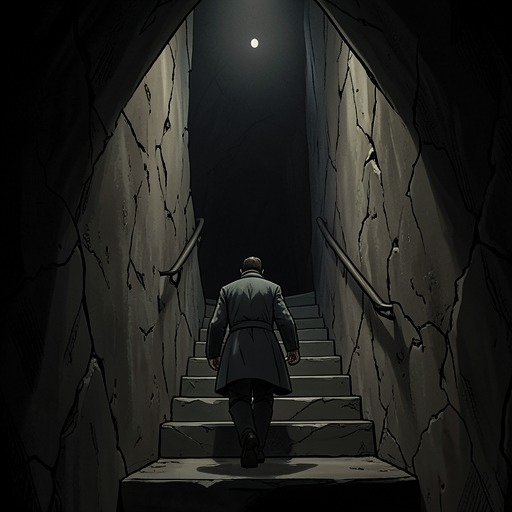
The recurring named spaces of the house—the Infinite Corridor, the Anteroom, the Great Hall, and the Spiral Staircase—exist for everyone, but their dimensions and layouts sometimes change. Other areas do not even replicate a consistent pattern twice. This mixture of recurrence and variation prevents both total randomness and dependable architecture. The explorers can recognize structures, but recognition does not grant control. The labyrinth remains legible enough to invite method and unstable enough to defeat mastery.
Narrative and Thematic Significance
The Labyrinth organizes the book’s account of space as a problem of representation. Echoes can establish that distance exists, but they cannot adequately describe a place in which distance is radically distorted. A film may preserve evidence of corridors and rooms, yet the arrangement of those images cannot be converted into a final map. The result is a schismatic representation: the record preserves fragments of spatial experience while exposing the impossibility of assembling them into an immutable whole.
Its deepest consequence is that no universal route or definitive interpretation can be guaranteed. A maze may exceed even its designer’s imagination, as the Daedalus tradition suggests, and the house appears to operate in precisely that manner. Because of its wall-shifts and extraordinary scale, an exit is singular to the person taking it, on that path, at that time. No outside authority—not even a god or an imagined Other—can comprehend the entire structure well enough to provide a final answer. Solutions are therefore necessarily personal, and loss carries the absolute possibility of death.
The Labyrinth finally joins physical disorientation to the limits of reading and self-knowledge. The house cannot be surveyed from above, and the film cannot be mastered through a complete overview; both force understanding to emerge through partial passage, repetition, interruption, and return. Its terror lies not only in darkness or confinement but in the collapse of the reassuring belief that every structure has a stable center, every measurement a coherent relation, and every journey a route that can be known in advance.